Flexible industrial robot dynamics and control
6 Jan 2026
·
1 min read
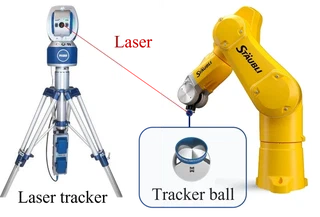
Industrial robots change stiffness and vibration behavior with their position and posture. This project establishes dynamic models that capture both joint and link flexibility without making the model too costly to use in control.
Approach
- Represent geometrically nonlinear links with strain-based beam elements and modal coordinates.
- Identify configuration-dependent vibration from experimental data.
- Generate nonlinear filtered B-spline trajectories that suppress motion-induced vibration.
- Validate compensation strategies on industrial robotic platforms.
Why it matters
More accurate dynamic models allow robots to move faster while maintaining precision. The same methods support robotic machining, additive manufacturing, and large-reach manipulation.
