Sensorless contact wrench estimation for industrial robots

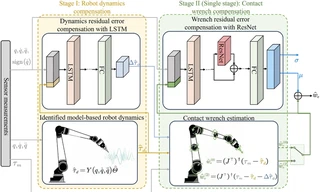
Robots used for polishing, assembly, and manipulation need reliable contact-force feedback. A six-axis wrist force/torque sensor provides direct measurements, but adds cost, wiring, payload, and integration constraints. This project estimates the same six-dimensional contact wrench from signals already available on the robot: joint motion and motor current.
Dual-stage estimation
The estimator combines a physics-based robot model with two learned residual corrections:
- Free-space dynamics compensation. An LSTM learns joint-torque errors caused by friction, backlash, hysteresis, parameter mismatch, and torque-conversion bias using contact-free trajectories.
- Contact wrench compensation. A temporal encoder and residual network correct the remaining task-space error during contact and predict an input-dependent uncertainty for each wrench axis.
Separating these responsibilities keeps the estimate anchored to robot mechanics while allowing each learning stage to focus on a distinct error source.
Experimental validation
The method was evaluated on a six-axis industrial manipulator. A cable-and-pulley rig applied loads of 0.5, 1.0, and 1.5 kg from multiple directions. A wrist load cell sampled at 1 kHz supplied training labels and evaluation ground truth, but was not used as an input during sensorless inference.
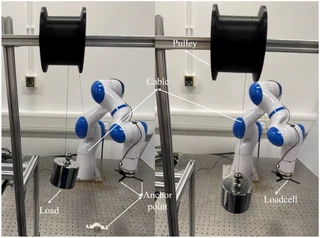
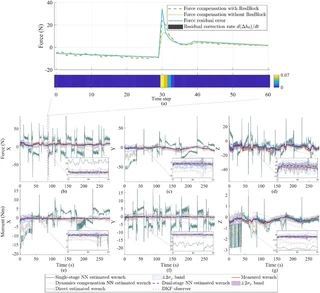
Stage I reduced the Joint 1 residual-torque RMSE from 4.2649 to 0.8591 Nm and the Joint 2 RMSE from 3.1453 to 1.0069 Nm. Across the final six-axis wrench evaluation, the dual-stage method achieved the lowest reported RMSE, maximum error, and relative error on every force and moment axis.
| Metric | Fx | Fy | Fz | Mx | My | Mz |
|---|---|---|---|---|---|---|
| RMSE | 1.5959 N | 0.7067 N | 1.9678 N | 0.1367 Nm | 0.1141 Nm | 0.0538 Nm |
| Maximum error | 5.9546 N | 4.4262 N | 5.3414 N | 0.7739 Nm | 0.4898 Nm | 0.4104 Nm |
| Relative error | 13.8% | 5.8% | 13.4% | 17.6% | 22.2% | 8.3% |
Why it matters
The main contribution is not simply a deeper network, but a physically meaningful decomposition of the estimation problem. The intermediate output makes each correction inspectable, while the probabilistic second stage provides a condition-dependent confidence signal. This creates a practical path toward lower-cost force-aware robots and future closed-loop force control without a permanently installed wrist sensor.
